
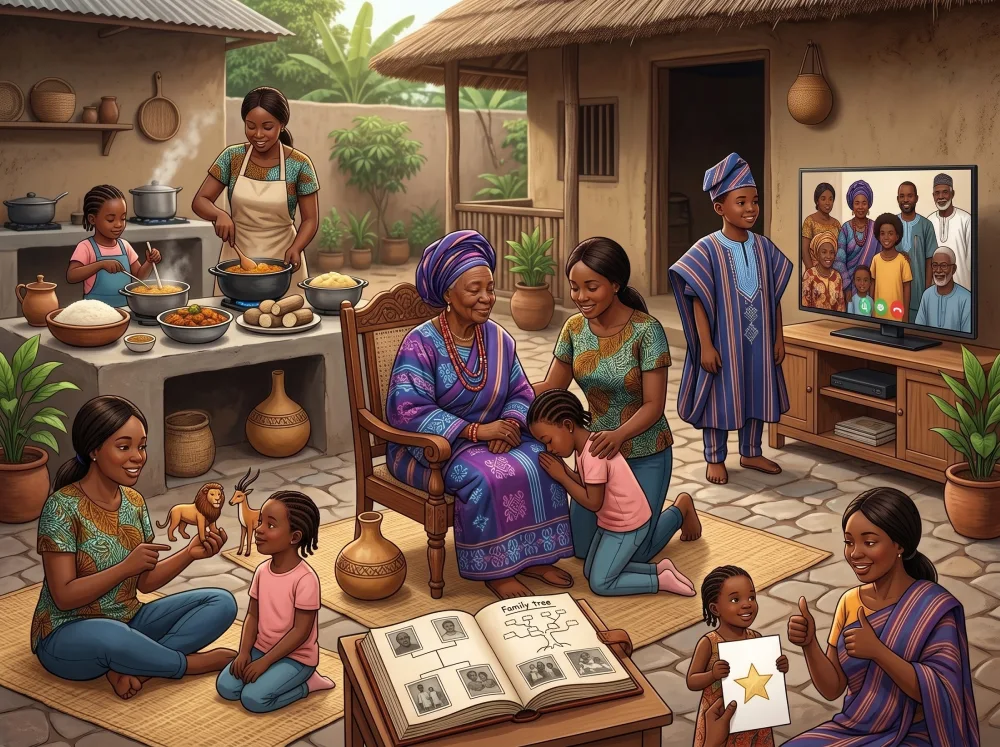
It’s possible to teach a child Yoruba vocabulary and grammar and still miss the point. Language without cultural context is just words, technically correct, but disconnected from the identity it’s supposed to carry. For diaspora families, that distinction matters more than it might seem at first.
Language is the vehicle, not the destination
A child who can conjugate Yoruba sentences correctly but has no sense of what it means to be Yoruba, no understanding of proverbs, family structure, respect customs, or heritage, has learned a skill, not an identity. The goal for most diaspora parents was never really “my child speaks Yoruba.” It was “my child knows where they come from.” Language is how you get there, but it isn’t the whole journey.
Proverbs carry more than words
Yoruba proverbs (òwe) are a good example of why culture and language can’t really be separated. A proverb isn’t just a sentence to translate; it’s a piece of accumulated wisdom, passed down specifically to teach a lesson through language. Understanding the words without understanding what the proverb is teaching means missing most of its value. This is why proverbs and folktales are typically introduced as children move into intermediate learning, once they have enough language foundation to actually absorb the meaning, not just the vocabulary.
Identity questions show up earlier than parents expect
Children as young as 6 or 7 start noticing differences: that their name is harder for classmates to pronounce, that their household smells or sounds different from their friends’, that they don’t fully understand references their cousins make on video calls with family back home. Left unaddressed, these small moments can quietly turn into quiet embarrassment about heritage rather than pride in it. This is exactly why the ideal window to introduce Yoruba language and culture is early, ages 5 to 12, while identity is still forming, not after a child has already decided that being different is something to downplay.
Pride is taught, not assumed
Cultural pride doesn’t happen automatically just because a child has Yoruba parents. It’s built the same way any other belief is built in a child, through repeated, positive exposure. A child who grows up hearing Yoruba spoken warmly, celebrated in songs and stories, and connected to people they love, tends to grow into an adult who feels genuine pride in that heritage. A child who only encounters it as an obligation, or not at all, often doesn’t.
What this means practically
If you’re choosing how to introduce Yoruba to your child, look for an approach that treats culture as inseparable from language, not an add-on. That means:
- Songs and stories rooted in actual Yoruba tradition, not generic language-app content translated into Yoruba
- Instructors who understand and can explain cultural context, not just grammar
- A curriculum that grows into cultural depth as children advance: proverbs, folktales, and eventually deeper cultural presentations
- A community of other diaspora children going through the same experience, so it doesn’t feel isolating
This is the foundation Imo Hub Academy is built on. Every level blends language with cultural education, so children don’t just learn to speak Yoruba; they learn what it means to be Yoruba.
Book a free trial class and see the difference for yourself.