
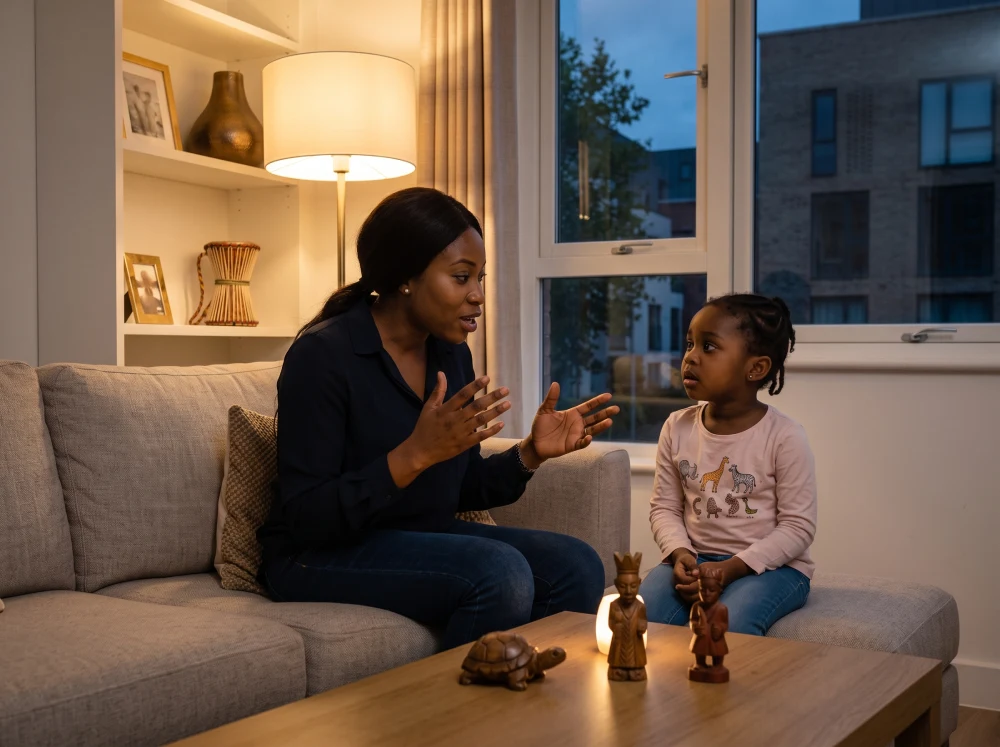
If you’re raising children outside Nigeria, you’ve probably had this moment: your child says something in English that would have come out effortlessly in Yoruba if you were back home, and it catches you off guard. Not because it’s wrong, but because it’s a small sign of a bigger gap, one that opens up quietly, over years, without anyone deciding it should.
You’re not failing your child by living abroad. But if you want Yoruba to survive in your household, it does take a plan. Here’s what actually works.
Start with why it matters to you
Before anything practical, get clear on your own reason. “I want them to speak Yoruba” is a fine start, but it’s not specific enough to build a habit around. Is it about talking to grandparents without a translator? Understanding proverbs your own parents used to say? Feeling like they belong at family gatherings instead of standing quietly on the edge of a conversation? Naming the real reason will help you stay consistent when it gets hard, and it will help your child understand why this matters, not just that it does.
Make it part of daily life, not a special event
Language sticks when it’s ordinary, not when it’s a scheduled lesson your child dreads. Small, repeated exposure beats occasional immersion. A few ways to weave Yoruba into daily life without turning it into homework:
- Greet each other in Yoruba every morning and evening, consistently, so it becomes automatic rather than a performance.
- Name common household items and routines in Yoruba first, English second.
- Play Yoruba music during car rides or meal prep, even if no one’s actively “studying” it.
- Tell one bedtime story a week in Yoruba; simple ones are fine, the goal is exposure, not perfection.
Don’t wait for fluency to use it
A lot of parents hold back speaking Yoruba with their kids because their own Yoruba feels rusty, incomplete, or “not good enough.” Push past that. Children don’t need a perfect model; they need consistent exposure. Speaking broken Yoruba with your child is still infinitely more valuable than speaking none at all.
Give them structure outside the home too
Even with the best home effort, most diaspora children benefit from structured, age-appropriate instruction alongside what happens at home- something with real curriculum, feedback, and other kids their age working through the same thing. Learning alongside peers matters more than most parents expect. Kids notice when other children their age are also learning Yoruba, and it turns something that could feel isolating into something normal, even fun.
Be patient with the plateau
There will be a stretch where progress feels invisible. Your child understands more than they can say, or they can say things but seem embarrassed to try. This is normal for any language learner, not a sign that it’s not working. Keep the exposure steady and let comprehension build ahead of speaking; that’s how language acquisition actually works.
If you’re looking for the structured piece to go alongside what you’re already doing at home, Imo Hub Academy offers live, small-group Yoruba classes for children ages 5–12, built specifically for diaspora families. Book a free trial class and see what a consistent, age-appropriate structure can add to the work you’re already doing.